
info@sadnica.ba+387 66 763 696


Select your language
Select your language
 0
0Select your language
Sauvignon Blanc, Muscat Silvaner
France
Cober 5 bb
Mid-September
This variety originates from western France, in the Loire Valley and Bordeaux regions. Its exact origin remains a mystery and is still under research. What is known is that Sauvignon Blanc was crossed with Cabernet Franc, producing the world’s most famous red grape variety: Cabernet Sauvignon. Recent DNA analyses suggest it is likely a descendant of Traminer. Sauvignon Blanc ranks among the finest white wines, often with a slightly greenish hue. The wine is harmonious, full-bodied, and reminiscent of grass, with a strong aromatic presence. It is frequently described as smelling of fresh grass or tropical fruits.
The flesh of the grape is sweet, with a pronounced varietal flavor. Sauvignon Blanc grapes have a very distinctive and easily recognizable aromatic profile. In cooler regions, wines display high acidity with aromas of freshly cut grass, elderflower, green pepper, and nettle, alongside green apple, grapefruit peel, and subtle tropical fruit notes (passion fruit, mango, papaya). In warmer climates, aromatic intensity decreases, and notes lean more toward peach, ripe melon, fig, green olives, and asparagus.
Clusters are small and compact, short, cylindrical, sometimes branched, on short pedicels, with an average of 1.2 clusters per shoot. Cluster weight ranges from 60 to 100 grams. Berries are round, medium-sized, yellow-green, with thick skins and fine black specks. The pulp is dense, sweet, and distinctly flavored. At normal ripeness, sugar content ranges from 19–24% with acidity of 6–7‰. Sauvignon Blanc generally has high acidity, full-bodied taste, with mineral, grassy, and grapefruit aromas. Depending on climatic conditions, it contains 12.5–14% alcohol. Wines from this variety are usually dry, table white wines.
Self-pollinating.
Sauvignon Blanc is relatively resistant to low temperatures. It has moderate susceptibility to fungal diseases, especially botrytis. It is more sensitive to pests that inhabit dense foliage, thus requiring timely green pruning.
You can purchase seedlings of Sauvignon Blanc grape at our garden center in the nursery located at Gornjem Crnjelovu, Glavna 65a.
Upon collection of the goods (seedlings), the Agromedžik nursery no longer has the possibility of supervision or care, and therefore cannot provide any further guarantee. Since seedlings are living beings, it is not possible to give a guarantee even a day after they leave the nursery. We cannot influence their maintenance and care, and consequently their further growth and development.
Our plants regularly undergo phytosanitary and vegetative inspections, therefore we do not have diseased or infected plants.
The depth of the pit is 40-50 cm, and the width is 30-40 cm.
First, a 5-6 cm layer of loose, fertile soil is placed at the bottom of the pit.
Cut the root of the vine seedling to 10 to 12 cm from the main stem (substrate).
Insert the vine seedling into the hole at an angle of 45°. The connection point of the coil should be 2-3 cm above the ground surface.
Once the seedling is placed in the hole, a layer of crumbly, fertile, and moderately moist soil is spread over the roots. The applied soil layer is then firmly pressed down.
The graft is supported by hand below the grafting point so that it does not move during pressing and compacting.
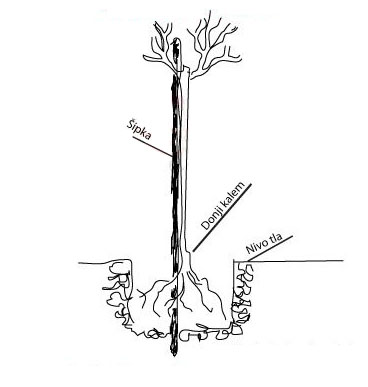
After the pressing and compacting of the soil is completed, the seedling is watered with 5 liters of water.
Then the remaining upper part of the hole is filled with a mixture of soil and organic fertilizer. The soil is first mixed with well-rotted manure, and then this mixture is poured into the hole and firmly compacted by pressing.
In autumn planting, apply finely crumbled soil over the planted seedling and form a mound so that only 1–2 cm of the branches remain exposed. The mound protects the seedling from freezing during the winter.
In spring planting, it is not necessary to form a mound.


