
info@sadnica.ba+387 66 763 696


Select your language
Select your language
 0
0Select your language
Moldavia, Kodryanka Kasno, Black Prince
Moldova
Cober 5 bb
late September, early October
Moldova is a highly successful combination of positive traits from the parent varieties Seiv Villar 12-375 and Guzalj Kara, created in Moldova. It is a high-quality table grape variety, very popular in local regions, especially in home gardens. Fresh grapes are used as a dessert, in compotes, juices, and preserves. The fruit remains on the vine for an extended period and, once harvested, can be stored for a long time in cold storage. It also tolerates transport very well.
The flesh has a pleasant, sweet, and refreshing taste, without a distinctive aroma.
The cluster is large and loose, with an average weight of 350 to 1000 grams. Berries are oval, large, approximately 2.5 cm in height, nearly 2 cm in width, weighing 6 to 7 grams, dark blue in color, and attached to a long peduncle.
Self-pollinating.
A resistant table grape variety. It is significantly more tolerant to low temperatures compared to most table grape varieties. Not susceptible to fungal diseases. Moderately sensitive to phylloxera.
You can purchase seedlings of Moldova grape at our garden center in the nursery located at Gornjem Crnjelovu, Glavna 65a.
Upon collection of the goods (seedlings), the Agromedžik nursery no longer has the possibility of supervision or care, and therefore cannot provide any further guarantee. Since seedlings are living beings, it is not possible to give a guarantee even a day after they leave the nursery. We cannot influence their maintenance and care, and consequently their further growth and development.
Our plants regularly undergo phytosanitary and vegetative inspections, therefore we do not have diseased or infected plants.
The depth of the pit is 40-50 cm, and the width is 30-40 cm.
First, a 5-6 cm layer of loose, fertile soil is placed at the bottom of the pit.
Cut the root of the vine seedling to 10 to 12 cm from the main stem (substrate).
Insert the vine seedling into the hole at an angle of 45°. The connection point of the coil should be 2-3 cm above the ground surface.
Once the seedling is placed in the hole, a layer of crumbly, fertile, and moderately moist soil is spread over the roots. The applied soil layer is then firmly pressed down.
The graft is supported by hand below the grafting point so that it does not move during pressing and compacting.
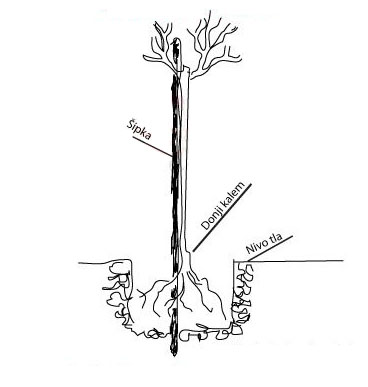
After the pressing and compacting of the soil is completed, the seedling is watered with 5 liters of water.
Then the remaining upper part of the hole is filled with a mixture of soil and organic fertilizer. The soil is first mixed with well-rotted manure, and then this mixture is poured into the hole and firmly compacted by pressing.
In autumn planting, apply finely crumbled soil over the planted seedling and form a mound so that only 1–2 cm of the branches remain exposed. The mound protects the seedling from freezing during the winter.
In spring planting, it is not necessary to form a mound.


