
info@sadnica.ba+387 66 763 696


Select your language
Select your language
 0
0Select your language
-
Serbia
Cober 5 bb
late August, early September
Lasta is a table grape variety developed at the Faculty of Agriculture in Novi Sad by crossing Muscat de St. Vallier and Moldovan grapes, as well as the interspecific table grape Ljana. It was officially recognized in 1991. The authors of this variety are Petar Cindrić and Nada Korać. As a high-quality table grape, it is suitable for commercial production as well as cultivation on smaller plots and home gardens. This variety has a strong, five-lobed leaf, suitable for trellising and garden pergolas, and belongs to the group of low-spraying grapes. The clusters can remain on the vine for a long time, even until the first frosts, without losing acidity or rotting. It also transports very well over long distances.
The flesh has a fine, mild, and muscat flavor.
The cluster is visually attractive, medium-sized, loose, with large, oval, uniform berries of greenish-yellow color. The skin is thin and tender, and the pulp is exceptionally crisp. Sugar content reaches about 19%, but due to the high acidity, the grapes taste slightly tart.
Self-pollinating.
Regular protection against powdery mildew is necessary, as the variety is highly sensitive to it, while protection against downy mildew and gray rot can be omitted. Lasta is more sensitive to frost than Muscat Hamburg but more resistant than Afus Ali. It is also more sensitive to drought than other table grape varieties, so irrigation is recommended.
You can purchase seedlings of Lasta grape at our garden center in the nursery located at Gornjem Crnjelovu, Glavna 65a.
Upon collection of the goods (seedlings), the Agromedžik nursery no longer has the possibility of supervision or care, and therefore cannot provide any further guarantee. Since seedlings are living beings, it is not possible to give a guarantee even a day after they leave the nursery. We cannot influence their maintenance and care, and consequently their further growth and development.
Our plants regularly undergo phytosanitary and vegetative inspections, therefore we do not have diseased or infected plants.
The depth of the pit is 40-50 cm, and the width is 30-40 cm.
First, a 5-6 cm layer of loose, fertile soil is placed at the bottom of the pit.
Cut the root of the vine seedling to 10 to 12 cm from the main stem (substrate).
Insert the vine seedling into the hole at an angle of 45°. The connection point of the coil should be 2-3 cm above the ground surface.
Once the seedling is placed in the hole, a layer of crumbly, fertile, and moderately moist soil is spread over the roots. The applied soil layer is then firmly pressed down.
The graft is supported by hand below the grafting point so that it does not move during pressing and compacting.
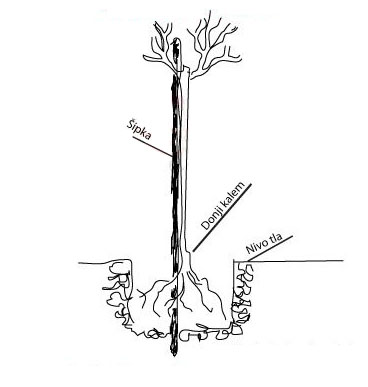
After the pressing and compacting of the soil is completed, the seedling is watered with 5 liters of water.
Then the remaining upper part of the hole is filled with a mixture of soil and organic fertilizer. The soil is first mixed with well-rotted manure, and then this mixture is poured into the hole and firmly compacted by pressing.
In autumn planting, apply finely crumbled soil over the planted seedling and form a mound so that only 1–2 cm of the branches remain exposed. The mound protects the seedling from freezing during the winter.
In spring planting, it is not necessary to form a mound.


